Vale on Vale
One of the paintings featured in CAM's current exhibition Framed is an important work by May Vale, 'Faith Learning her Lesson'.
This reflection on the career of May Vale is written by Dianne Vale. Dianne is a great-niece of May Vale and has a strong interest in her family history.The Vale family has a long association with Castlemaine having emigrated from England in 1853 and settled in Castlemaine where May's father opened a bookstore and later became a local politician for the Colony of Victoria.
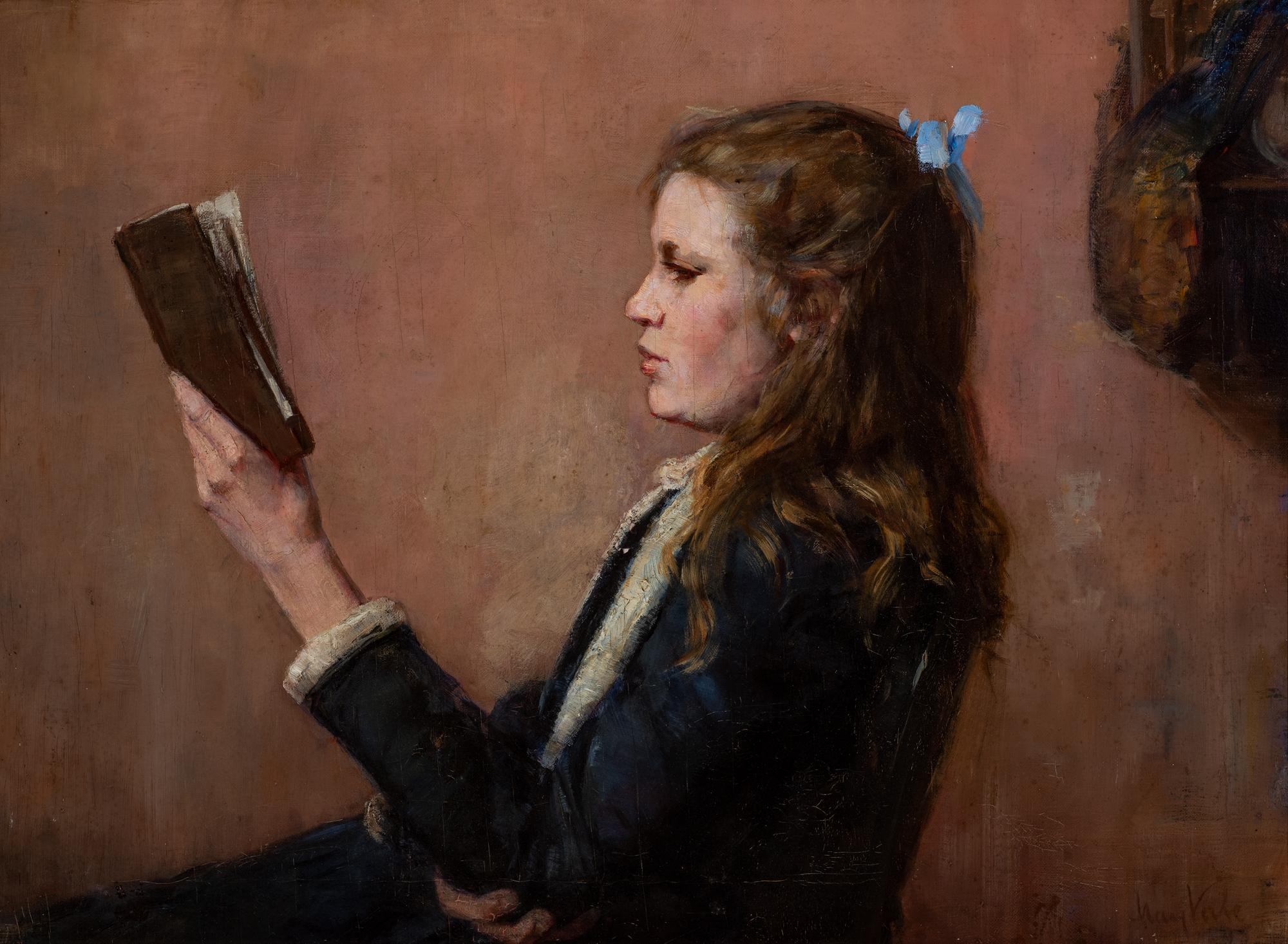
May Vale (1862-1945)
Born in Ballarat, May was the third of eleven children of William Mountford Kinsey Vale stationer, barrister and politician, and Rachel Vale (nee Lennox). William’s family initially settled in Castlemaine having travelled from Herefordshire, England in 1853.
May was a painter of portraits, still life and landscapes mostly in oils but also watercolours. She was a pioneer in enamel painting, particularly of miniature portraits and landscapes.
May was schooled in Melbourne, and when the family moved back to England for 5 years in 1874, she attended the Royal School of Art in South Kensington. In 1879 May enrolled at the National Gallery School under George Follingsby and Frederick McCubbin, and later at the School of Painting in Melbourne. Unlike her contemporaries, such as Jane Sutherland and Clara Southern, May travelled internationally three times, actively taking part and contributing to an international sphere; a sphere integral to her practice. She was interested in painting en plein air and this was heightened after a study tour of Italy, Paris and London around 1890 during which she was influenced by French Impressionism. She studied watercolour under Sir James Linton, President of the Royal Society of Watercolour Painters,and in Paris at the Académie Julian under Jules Lefebvre and Robert Fleury.

May established her own art school in 1893 in Collins Street, taking students on plein-air painting excursions, and over several years ran a number of art school studios in Melbourne’s CBD taking portrait commissions herself and widely exhibiting in major exhibitions. One of her students was A M E Bale who is well represented at Castlemaine Art Museum.
She was commissioned by Victoria’s chief botanist Ferdinand von Mueller to produce 220 native Victorian timber cut panels depicting fruit, flowers and leaves for the 1886 Indian and Colonial Exhibition in England (panels now held at Museum Victoria). In 1906 May travelled to London where she studied enamelling at the Chelsea Polytechnic and attended the Burbeck Institute. Back in Melbourne her work was exhibited at the Australian Exhibition of Women’s Work in 1907. She was a pioneer in enamel painting, particularly miniature portraits and landscapes. It was a difficult medium in which she excelled, and she had her own kiln situated in her studio on the corner of William and Collins Streets.
May was a strong fighter for the recognition of the professional standing of women artists and was an active member of the Victorian Women’s Suffrage Society. She was the first women elected a member of the Buonarotti Society in 1883 and was one of the first women elected a councillor of the Victorian Artists’ Society (1900-1904). She was also a Foundation Member of the Yarra Sculptors’ Society.

One of her major works The Orchard c.1904 (NGV) was strongly influenced by the Barbizon School in France. Exhibitions of her work were held from 1895 to 1932 at the VAS and various galleries including Bessant Hall, Athenaeum, Women’s Art Club. She was described as independent, tall, outgoing and animated. She enjoyed strong lifelong friendships with artists including McCubbin, and Tom Roberts, and is represented at the NGV, AGNSW, Castlemaine and Warrnambool galleries.
The Lyceum Club, where May was an early member with her sister Grace, holds some of her paintings. Grace Vale was also an active suffragette, who led a campaign for women to be admitted to study Medicine. Grace was in the first intake of women to Medicine at the University of Melbourne in 1887, and having graduated, practised in Collins Street Melbourne, Ballarat and NSW. Throughout her life she was a strong advocate to improve health conditions for women and children. Another sister, Beatrice, was a published writer, poet and playwright.
Dianne Vale (great niece of May Vale)
September 2025
